7 Best GTM Engineering Agencies for B2B in 2026 (Ranked and Reviewed)
 3 min read
What Is a GTM Engineering Agency?
A GTM engineering agency designs, builds, and operates the automated systems that power a B2B company’s go-to-market motion. Instead of adding headcount to scale outbound, these agencies deploy signal-based prospecting infrastructure, AI-personalised outreach, and CRM automation building a revenue engine that compounds over time.
GTM engineering agencies are distinct from traditional marketing agencies or SDR outsourcing firms. They focus on infrastructure: Clay workflows, outreach stack configuration, intent signal routing, and RevOps automation. The output is not a campaign it is a system your team can operate and own.
How to Choose a GTM Engineering Agency
Before comparing agencies, clarify what you actually need. GTM engineering covers a wide range some agencies specialise in outbound automation, others in CRM build-outs, and others in full-stack revenue infrastructure.
Five criteria to evaluate
- System ownership: Does the client own the infrastructure the agency builds, or is it locked into the agency’s proprietary platform?
- Outbound capability: Can the agency run signal-based prospecting and AI-personalised outreach, or only CRM management?
- Speed to results: How quickly does the agency deploy? Days or months?
- ICP precision: Does the agency use buying signals to identify in-market accounts, or rely on static lists?
- Documentation: Is every workflow documented so your team can operate independently post-engagement?
The 7 Best GTM Engineering Agencies for B2B in 2026
DevCommX is best for AI SDR and signal-based outbound, with a high outbound focus using tools like Clay, HeyReach, Smartlead, and HubSpot, operating on a monthly retainer model.
GTM6 is ideal for VC-backed startups, offering a medium outbound focus with tools such as Clay, Salesforce, and Outreach, working on a project plus retainer model.
DarwinApps GTM serves SaaS companies with $10M–$100M ARR, with a medium outbound focus using HubSpot, Clay, and Apollo, primarily on a retainer basis.
FullFunnel.co is best for content-led GTM, with a low outbound focus and a stack centered around HubSpot and LinkedIn, following a retainer model.
gtm-engineering.io specializes in CRM automation, with a low outbound focus using Salesforce, HubSpot, and Zapier, operating as a fractional service model.
Earleads focuses on B2B pipeline generation, with a high outbound focus using Apollo and Instantly, and works on a retainer model.
GTME HQ is focused on finding GTM engineer talent, functioning more as a staffing partner rather than an outbound agency, and follows a placement fee model.
1. DevCommX: Best Overall for AI SDR Systems and Signal-Based Outbound
DevCommX is our top pick for B2B companies that want GTM engineering delivered as a working, owned system rather than a strategy deck. DevCommX builds autonomous AI SDR outbound infrastructure: signal-based prospecting, AI-personalised multi-channel outreach, and RevOps automation — deployed in as little as 18 hours and generating qualified demos within 72 hours of launch.
The key differentiator is system ownership. Every client gets a fully documented GTM infrastructure — Clay workflows, HeyReach and Smartlead campaigns, CRM structure, and signal triggers — that their team can operate independently after the engagement. There is no platform lock-in, and the system compounds instead of disappearing when the contract ends.
DevCommX is best suited to Series A–C B2B SaaS and service companies where outbound pipeline is the primary acquisition lever and the team wants to replace or reduce junior SDR headcount with automated infrastructure that they own.
- Deployment time: 18 hours
- Typical results: 20–40 qualified demos per month within 6–8 weeks
- Stack: Clay, HeyReach, Smartlead, HubSpot, Apollo
- Best for: B2B SaaS and service companies scaling outbound without hiring
- Model: Monthly retainer — client owns all deliverables
2. GTM6: Best for VC-Backed B2B Startups
GTM6 positions itself as a GTM engineering agency for VC-backed B2B startups. The agency focuses on building outbound infrastructure for early-growth companies that need to move quickly from product-market fit to repeatable pipeline.
GTM6’s approach centres on Clay-based outbound automation combined with Salesforce or HubSpot CRM setup. Best suited to pre-Series B startups with an established ICP and a clear sales motion that needs systematising.
- Best for: Seed to Series B VC-backed startups
- Stack: Clay, Salesforce, Outreach
- Model: Project-based + retainer
3. DarwinApps GTM: Best for SaaS at $10M–$100M ARR
DarwinApps is a GTM engineering agency focused on B2B SaaS companies between $10M and $100M ARR. Their methodology diagnoses bottlenecks across the GTM funnel from ICP definition and lead sourcing to CRM hygiene and pipeline visibility then builds infrastructure to resolve each bottleneck systematically.
DarwinApps is particularly strong for companies that have achieved initial traction but have a messy, manually operated GTM stack limiting growth. The agency ties every workstream to pipeline outcomes rather than activity metrics.
- Best for: SaaS companies $10M–$100M ARR with existing but disorganised GTM
- Stack: HubSpot, Clay, Apollo
- Model: Retainer with defined milestones
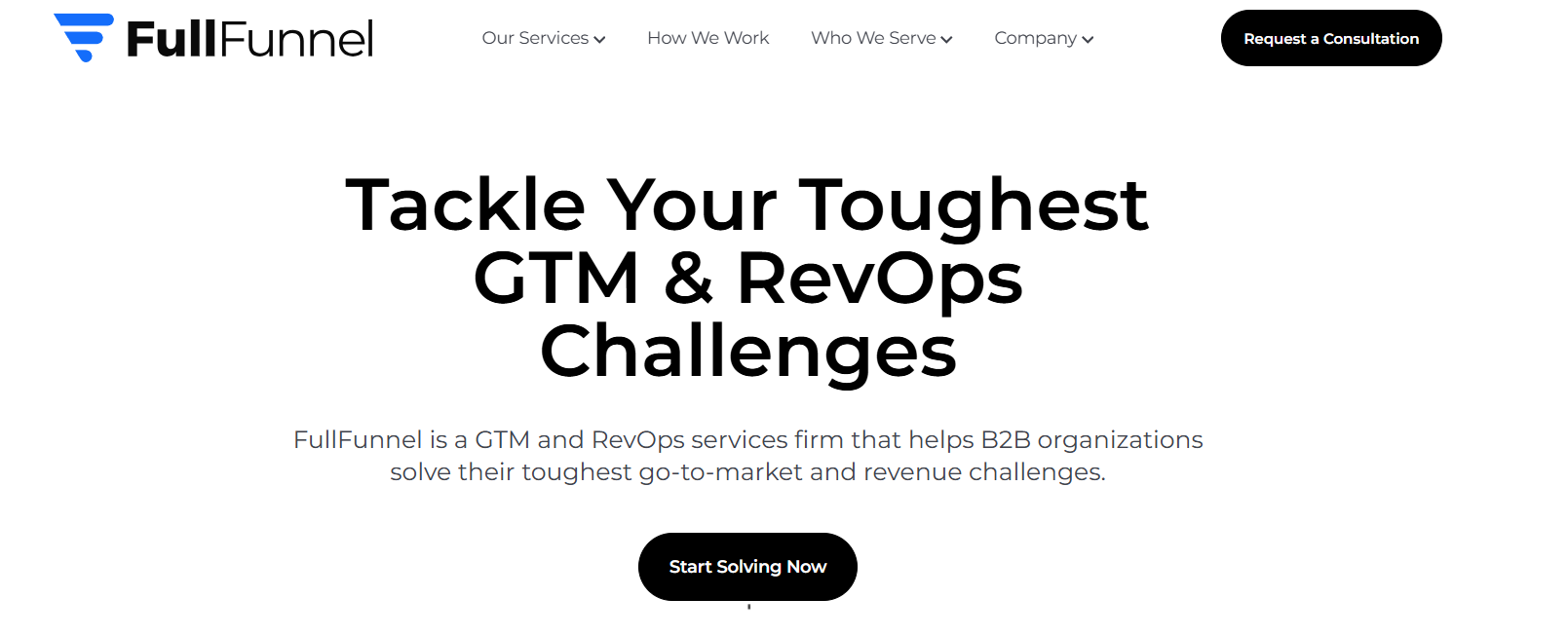
4. FullFunnel.co: Best for Content-Led GTM
FullFunnel takes a different approach to GTM engineering combining demand generation, content strategy, and RevOps automation. For B2B companies where content and brand are core to the GTM motion, FullFunnel is a stronger fit than outbound-first agencies.
FullFunnel’s GTM engineering services include LinkedIn-led demand generation, HubSpot CRM build-outs, and marketing automation for HubSpot CRM customers. They are less focused on cold outbound at scale and more on inbound-qualified pipeline.
- Best for: B2B companies with a content and inbound GTM motion
- Stack: HubSpot, LinkedIn, content tools
- Model: Retainer
5. gtm-engineering.io: Best for CRM Automation
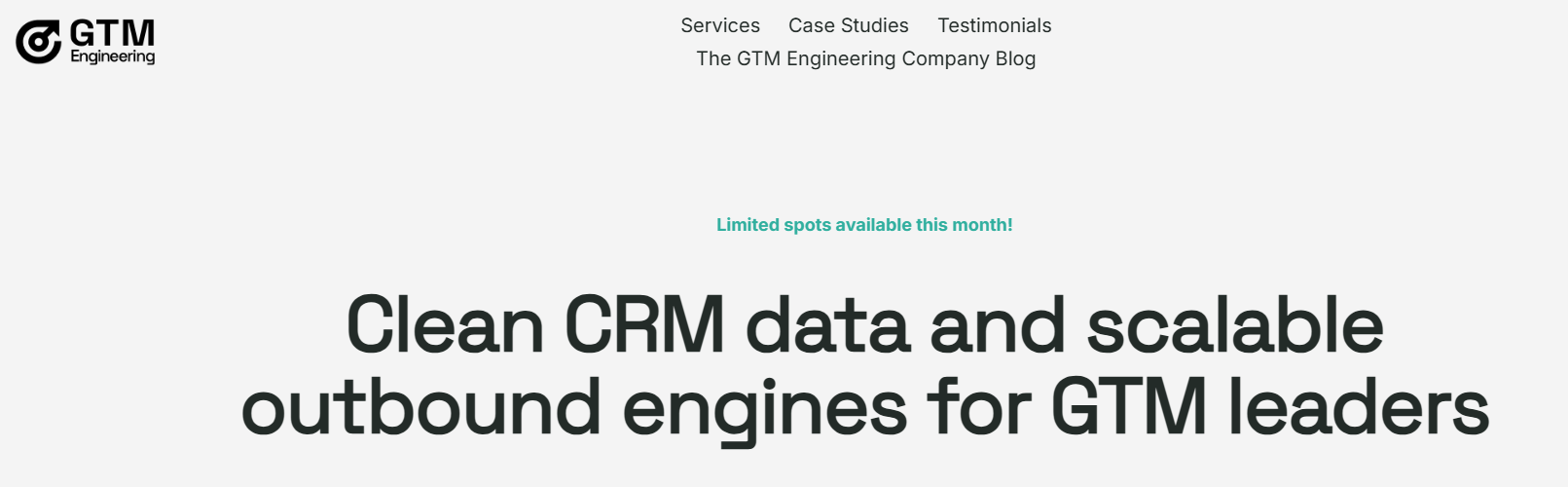
gtm-engineering.io delivers fractional GTM engineering with a focus on CRM cleanup and automation. The agency’s value proposition is pairing a RevOps strategist, data engineer, and outbound builder into a single fractional hire useful for companies that need operational GTM support rather than outbound execution at scale.
- Best for: Companies needing CRM cleanup and RevOps infrastructure
- Stack: Salesforce, HubSpot, Zapier, Clay
- Model: Fractional engagement
6. Earleads: Best for B2B Pipeline Generation
Earleads positions as a B2B pipeline generation agency with an outbound-first approach. The agency runs cold email and LinkedIn campaigns using Apollo and Instantly, with a focus on volume-based prospecting. Best suited for companies that want fast pipeline generation without building owned infrastructure.
- Best for: Companies wanting fast pipeline without owning the infrastructure
- Stack: Apollo, Instantly
- Model: Retainer
7. GTME HQ: Best for Finding GTM Engineers
GTME HQ is a specialist staffing platform for GTM engineering talent rather than a service delivery agency. If you want to build an in-house GTM engineering team, GTME HQ is a useful resource for finding pre-vetted GTM engineers.
- Best for: Companies building an in-house GTM engineering function
- Model: Placement fees

GTM Engineering Agency vs In-House GTM Engineer
| Factor | GTM Engineering Agency | In-House GTM Engineer |
|---|---|---|
| Time to deploy | Days to weeks | 4–8 weeks (hiring + ramp) |
| Annual cost | $72K–$144K (retainer) | $120K–$180K (salary + benefits) |
| Ramp time | Minimal | 60–90 days |
| Breadth of expertise | Full team across strategy, automation, and ops | Limited to one person’s skill set |
| System ownership | Depends on the agency — clarify before signing | Fully owned internally |
| Best when | Speed matters and infrastructure is the gap | GTM engineering is a core long-term function |
Frequently Asked Questions
What does a GTM engineering agency actually build?
A GTM engineering agency builds the technical infrastructure that powers your outbound and go-to-market motion. This includes signal-based prospecting systems (identifying in-market accounts using buying signals), Clay workflows for data enrichment and personalisation, outreach automation (email sequences, LinkedIn campaigns), CRM integrations, and reporting dashboards. The output is a working system, not a strategy document.
How much does a GTM engineering agency cost?
GTM engineering agencies typically charge between $6,000 and $12,000 per month on retainer. Project-based engagements for specific infrastructure builds range from $15,000 to $50,000. Compared to hiring a full-time GTM engineer ($120K–$180K salary), a retainer agency provides broader expertise at lower cost but without permanent headcount.
How long does GTM engineering take to show results?
The fastest GTM engineering deployments generate first replies within 72 hours of launch. More complex infrastructure builds take 4–8 weeks to reach full operation. Most companies see measurable pipeline impact within 6–8 weeks of engaging a GTM engineering agency.
What is the difference between a GTM engineering agency and a sales outsourcing firm?
A sales outsourcing firm provides human SDRs who manually prospect and send outreach. A GTM engineering agency builds automated systems that do the same work without manual effort per contact. The key difference is infrastructure vs headcount: a GTM engineering agency builds something that compounds and that you own; a sales outsourcing firm provides temporary capacity that disappears when the contract ends.
Do I need a GTM engineering agency or just outbound software?
If you have an in-house team comfortable with Clay, CRM integrations, and outreach automation, outbound software is sufficient. If you need the infrastructure designed, built, and operated and you don’t have that technical skill in-house, a GTM engineering agency delivers faster results. The core question is whether you have the capacity to build and maintain the system yourself.
Which GTM engineering agency is best for B2B SaaS?
DevCommX is best for B2B SaaS companies where outbound pipeline is the primary acquisition lever, particularly Series A–C companies scaling without proportionally scaling headcount. DarwinApps GTM is best for SaaS companies between $10M and $100M ARR that need to systematise a messy existing GTM stack. GTM6 is best for early-stage VC-backed SaaS companies needing to move quickly from product-market fit to pipeline.
DevCommX delivers GTM engineering end-to-end — outbound, inbound, and RevOps as one system.
👉Book a Free GTM Engineering Strategy Call
{“@context”:“https://schema.org”,“@type”:“FAQPage”,“mainEntity”:\[{“@type”:“Question”,“name”:“What does a GTM engineering agency actually build?”,“acceptedAnswer”:{“@type”:“Answer”,“text”:“A GTM engineering agency builds the technical infrastructure that powers your outbound and go-to-market motion. This includes signal-based prospecting systems, Clay workflows for data enrichment and personalisation, outreach automation (email sequences, LinkedIn campaigns), CRM integrations, and reporting dashboards. The output is a working system, not a strategy document.”}},{“@type”:“Question”,“name”:“How much does a GTM engineering agency cost?”,“acceptedAnswer”:{“@type”:“Answer”,“text”:“GTM engineering agencies typically charge between $6,000 and $12,000 per month on retainer. Project-based engagements for specific infrastructure builds range from $15,000 to $50,000. Compared to hiring a full-time GTM engineer ($120K to $180K salary), a retainer agency provides broader expertise at lower cost but without permanent headcount.”}},{“@type”:“Question”,“name”:“How long does GTM engineering take to show results?”,“acceptedAnswer”:{“@type”:“Answer”,“text”:“The fastest GTM engineering deployments generate first replies within 72 hours of launch. More complex infrastructure builds take 4 to 8 weeks to reach full operation. Most companies see measurable pipeline impact within 6 to 8 weeks of engaging a GTM engineering agency.”}},{“@type”:“Question”,“name”:“What is the difference between a GTM engineering agency and a sales outsourcing firm?”,“acceptedAnswer”:{“@type”:“Answer”,“text”:“A sales outsourcing firm provides human SDRs who manually prospect and send outreach. A GTM engineering agency builds automated systems that do the same work without manual effort per contact. The key difference is infrastructure vs headcount: a GTM engineering agency builds something that compounds and that you own; a sales outsourcing firm provides temporary capacity that disappears when the contract ends.”}},{“@type”:“Question”,“name”:“Do I need a GTM engineering agency or just outbound software?”,“acceptedAnswer”:{“@type”:“Answer”,“text”:“If you have an in-house team comfortable with Clay, CRM integrations, and outreach automation, outbound software is sufficient. If you need the infrastructure designed, built, and operated and you do not have that technical skill in-house, a GTM engineering agency delivers faster results. The core question is whether you have the capacity to build and maintain the system yourself.”}},{“@type”:“Question”,“name”:“Which GTM engineering agency is best for B2B SaaS?”,“acceptedAnswer”:{“@type”:“Answer”,“text”:“DevCommX is best for B2B SaaS companies where outbound pipeline is the primary acquisition lever, particularly Series A to C companies scaling without proportionally scaling headcount. DarwinApps GTM is best for SaaS companies between $10M and $100M ARR that need to systematise a messy existing GTM stack. GTM6 is best for early-stage VC-backed SaaS companies needing to move quickly from product-market fit to pipeline.”}}]}