.webp)
Introduction to Waterfall Enrichment in Modern Prospecting
If you've spent any real time in sales or growth roles, you already know the frustration: you pull a list of leads, run them through your enrirun them through your enrichment toolthe fields blank. Phone numbers missing. Job titles outdated. Emails that bounce.
That's not a problem, that's a data coverage problem. And waterfall enrichment is one of the most practical solutions the industry has landed on in recent years.
This article breaks down what waterfall enrichment actually is, how three of the most talked-about platforms Clay, ZoomInfo, and Apollo approach it differently, and which one is likely the right fit depending on where you are as a team.
No fluff. Just what you need to make a smart decision.
What Is Waterfall Enrichment and Why It Matters
Waterfall enrichment is a data strategy where you chain multiple data providers together in a sequence to a "waterfall" so that if one provider can't fill a field, the next one in line takes a shot at it.
Think of it like trying to verify someone's email address. Provider A might return the email for 60% of your list. Instead of stopping there and accepting 40% blanks, waterfall enrichment sends those incomplete records to Provider B, then Provider C, until you've maxed out your coverage.
Why does this matter? Because no single data vendor has complete, accurate coverage across every industry, geography, or company size. Relying on one source alone means gaps and gaps in prospect data mean missed outreach, wasted time, and lower conversion rates.
Waterfall enrichment became a bigger conversation as tools like Clay made it accessible to teams that weren't running enterprise data engineering setups. Suddenly, a three-person growth team at a startup could do what only large revenue ops teams could do before.
Understanding Clay for Waterfall Enrichment
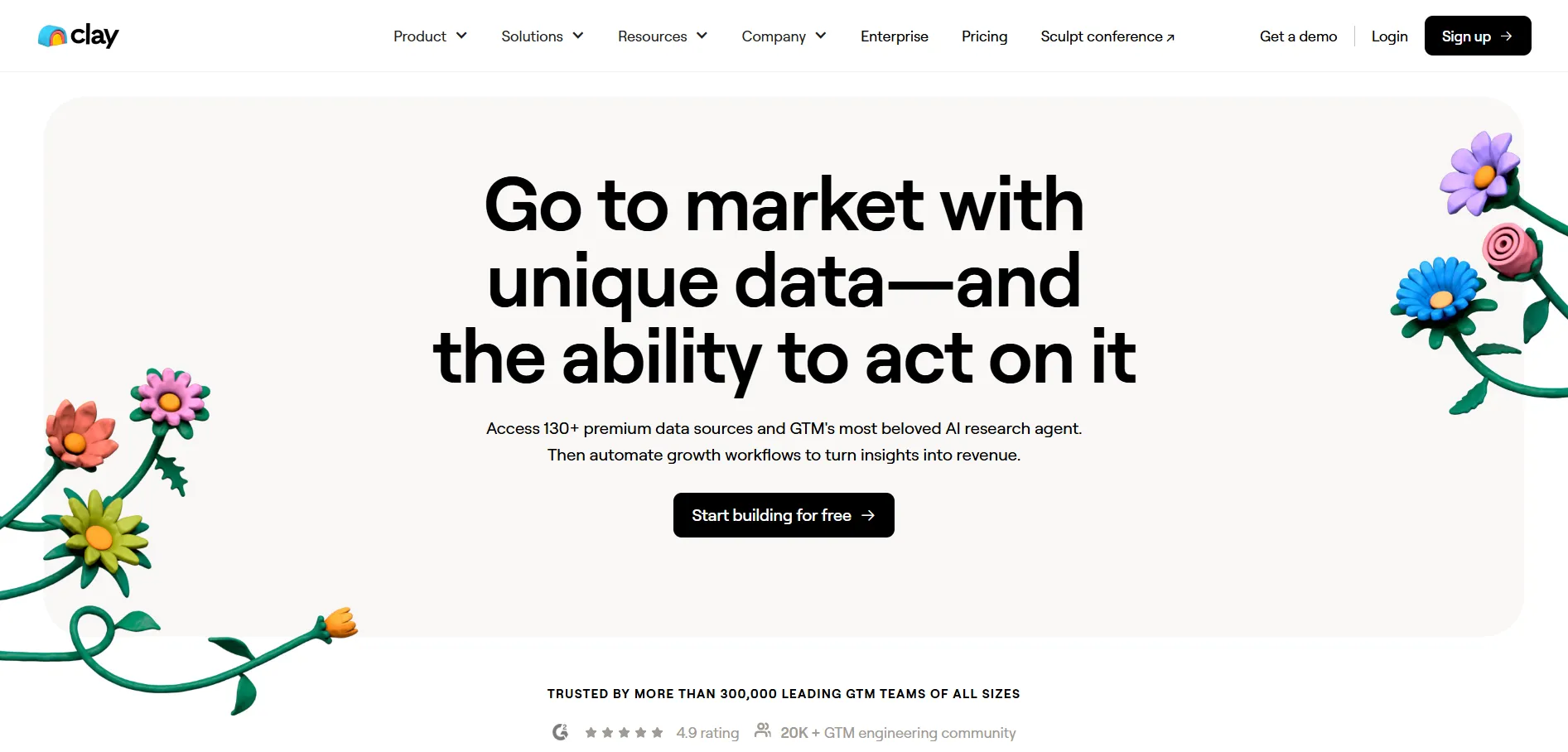
Clay is not a data provider in the traditional sense. It's more accurately described as an enrichment orchestration layer, a platform that connects to dozens of data sources and lets you build custom enrichment waterfalls without writing a single line of code (though it does support code if you want it).
At its core, Clay works by letting you set up a table similar to a spreadsheet where each row is a prospect or company record. You then define enrichment "waterfalls" by stacking multiple data providers for each field. If Clay can't find an email via Clearbit, it tries Hunter, then DropContact, then moves on. You only pay for successful enrichment hits depending on the provider, which keeps costs manageable.
What makes Clay genuinely powerful is the breadth of integrations. It connects to over 75 data sources including Apollo, LinkedIn via Proxycurl, Clearbit, Hunter, People Data Labs, Crunchbase, and more. You're essentially getting access to many providers through a single interface.
Clay also incorporates AI; it has a built-in AI feature called "Claygent" that can research prospects at scale, pull data from websites, LinkedIn profiles, and news articles, and populate fields that no standard data provider would touch. This is particularly useful for personalization at scale, which is where a lot of modern outbound lives.
The learning curve is real. Clay is genuinely flexible, but that flexibility comes with complexity. New users often spend a week or two just figuring out how to set up their first waterfall properly. The community and documentation are solid, but it's not a tool you'll have running on day one.
How ZoomInfo Supports Lead Enrichment
ZoomInfo is the incumbent in this space. It's been around since 2000, and for a long time it was simply the go-to option for B2B contact data, especially in enterprise environments.
From an enrichment standpoint, ZoomInfo takes a very different approach than Clay. Rather than letting you chain multiple external providers, ZoomInfo is itself the data source a massive proprietary database that they maintain through a mix of web crawling, partnerships, and user-contributed data (their contributors program, where users share their email contacts in exchange for credits, has been both a strength and a source of controversy).
ZoomInfo's enrichment capabilities work well within its own ecosystem. You can enrich CRM records through native integrations with Salesforce, HubSpot, and others, automatically keeping contact data fresh as job changes and company updates happen. Their "streaming intent data" and org chart features are genuinely useful for enterprise sales teams doing account-based strategies.
Where ZoomInfo falls short in the waterfall conversation is that it's essentially a single-source solution. If ZoomInfo doesn't have the contact, you're stuck. There's no built-in mechanism to pull from an alternative source when coverage gaps appear. You'd need to bolt on other tools alongside it to replicate what Clay does natively.
ZoomInfo is also expensive meaningfully so and pricing is not publicly listed. You're looking at contract negotiations, annual commitments, and packages that often bundle more than you need. For smaller teams, this can be a significant obstacle.

Apollo's Role in Prospect Data Enrichment
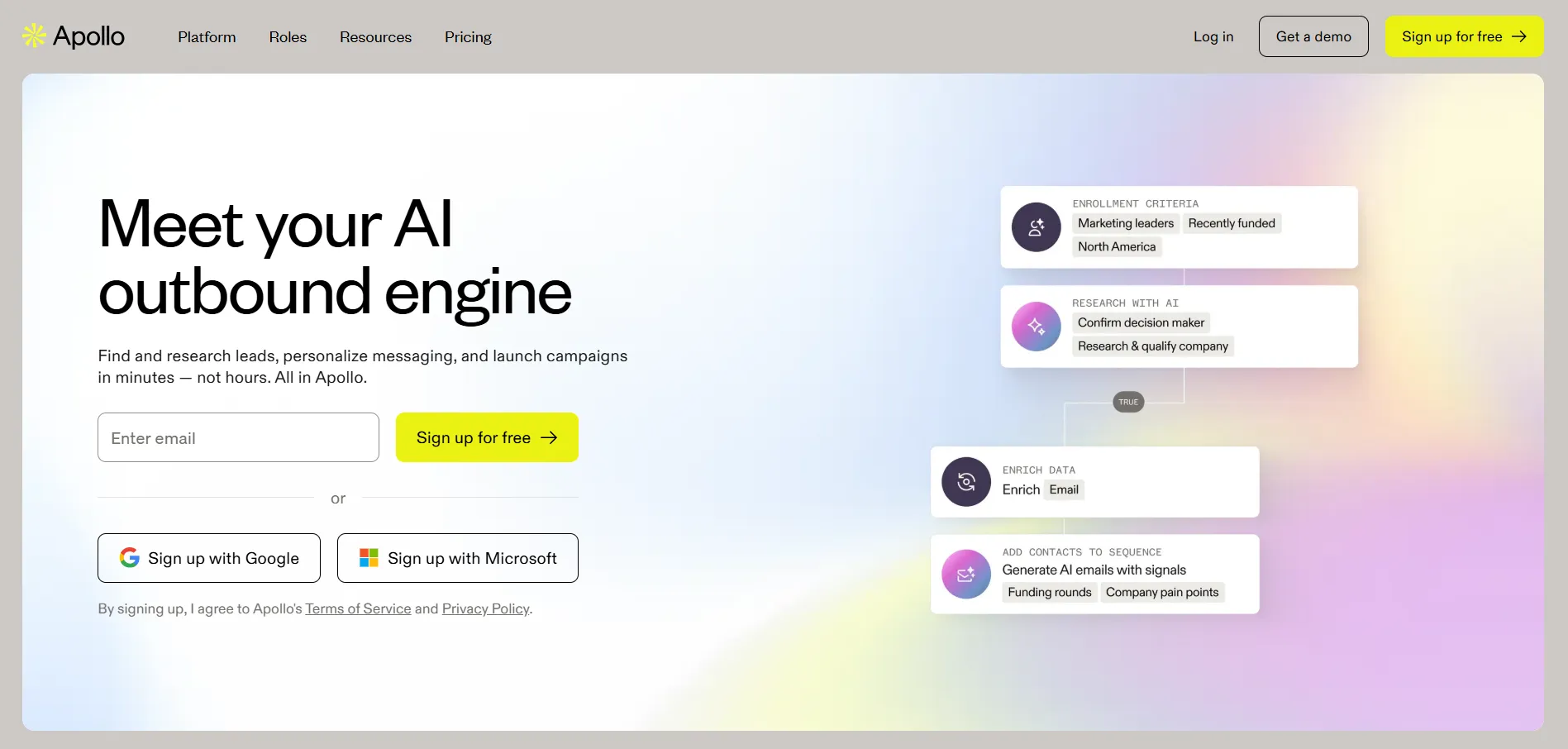
Apollo is often described as the scrappy alternative to ZoomInfo and to its credit, it earned that reputation by offering competitive data quality at a fraction of the price, along with a full sales engagement suite baked in.
Apollo's database holds over 275 million contacts and 73 million companies, and they've invested significantly in data accuracy over the past few years. Their enrichment features allow you to push data to your CRM, enrich existing records, and keep things updated through their "data health center."
Where Apollo stands out is value density. For a mid-market team that needs both prospecting data and sequencing in one platform, Apollo is hard to beat on price. It's not just an enrichment tool, it's an outbound engine. You can find leads, enrich them, build sequences, and track engagement all from the same interface.
However, Apollo is also primarily a single-source solution for enrichment. Like ZoomInfo, if a contact isn't in Apollo's database, you don't have a native waterfall fallback. Coverage can be inconsistent in certain geographies, particularly outside North America, and some users report mobile number data being weaker than ZoomInfo's.
Apollo does have an API, which means technically-minded teams can use Apollo as one provider within a Clay waterfall and many do. This hybrid approach captures Apollo's cost efficiency while preserving the multi-source coverage that waterfall enrichment is designed to deliver.
| Feature | Clay | ZoomInfo | Apollo |
|---|---|---|---|
| Data Sources | Aggregates 75+ providers, strongest for enrichment | Single-source proprietary database | Single-source proprietary database |
| Waterfall Logic | Built specifically for waterfall enrichment | No native waterfall mechanism | No native waterfall mechanism |
| AI-Powered Research | Claygent enables deep AI-driven prospect research | No comparable open-ended AI research | No comparable open-ended AI research |
| CRM Integration | Integrates with major CRMs but requires more setup | Deepest CRM integrations, especially with Salesforce | Solid CRM integrations |
| Sales Engagement | No sequencing, focused only on enrichment and workflows | Engage available as an add-on | Includes full sequencing |
| Ease of Use | Most complex to set up | Polished UI but steeper learning curve | Most accessible and easiest to use |
| Geographic Coverage | Depends on selected data providers | Stronger international coverage | Good coverage but less than ZoomInfo |
Data Accuracy and Coverage Across Platforms
This is where it gets nuanced, because accuracy depends heavily on use case, industry, and geography.
ZoomInfo generally leads on email deliverability rates for enterprise contacts in North America. Their data refresh rates are strong, and their intent data signals are useful for timing outreach. The complaints tend to center on SMB coverage and mobile number accuracy.
Apollo has improved dramatically and for many use cases is on par with ZoomInfo for email accuracy. They've been more transparent about their verification process and offer an email validation step before sending. Their SMB coverage is often stronger than ZoomInfo's.
Clay, because it aggregates multiple providers, can theoretically achieve higher combined coverage than either. The catch is that you need to configure the waterfall properly. The quality of your output depends on how well you've set up the chain and which providers you've included. Done right, Clay-powered enrichment consistently outperforms single-source solutions on coverage metrics.
A common approach sophisticated teams use: run Clay with Apollo as the primary source (for cost efficiency), with fallbacks to People Data Labs, Clearbit, and Hunter for fields Apollo misses.
Pricing Comparison and Cost Efficiency
| Platform | Pricing Model | Starting Cost | Cost Efficiency | Best For |
|---|---|---|---|---|
| ZoomInfo | Custom enterprise contracts | $15,000–$25,000+ per year | High cost, better suited for large teams with advanced needs | Enterprise teams with large budgets and strong Salesforce dependency |
| Apollo | Transparent per-user pricing | Free plan available; Paid plans from $49/user/month | Highly affordable and scalable for startups and mid-market teams | Startups, SMBs, and growing sales teams |
| Clay | Credit-based pricing model | Around $149/month + provider usage costs | Flexible and often lower per-record cost, but can increase at high volume | Agencies, enrichment-heavy teams, and workflow-focused operations |
Automation, Integrations, and Workflow Flexibility
If you're building enrichment into automated workflows triggered by CRM events, new form fills, inbound leads, the flexibility of the tool matters enormously.
Clay is built for this. You can connect it to tools like Zapier, Make (formerly Integromat), Slack, and various CRMs to create fully automated enrichment pipelines. A new lead comes in, hits Clay, gets enriched across multiple sources, gets AI-researched for personalization signals, and lands in your CRM or sequencing tool with everything filled out. No human touch required.
ZoomInfo has strong native integrations, particularly its Salesforce integration which can automatically enrich and update records in real time. But the workflow flexibility outside of that ecosystem is more limited.
Apollo integrates well with common sales tools and has Zapier support, but it's primarily designed around its own sequencing engine. Using Apollo purely as an enrichment data layer within a broader workflow requires some workaround.
For teams that want to build enrichment into the fabric of their entire go-to-market stack, Clay is the most capable platform. It's essentially middleware for your data layer.
Which Platform Is Best for Startups, Agencies, and Enterprise Teams
Startups (seed to Series B): Apollo or Clay. Apollo gives you a solid all-in-one platform at a price point that won't blow your budget. Clay is worth it if your team has the technical appetite to set it up and you're doing meaningful outbound volume where enrichment quality directly impacts revenue.
Growth-stage and mid-market companies: Clay becomes increasingly valuable here. As your outbound motion matures and you need more sophisticated personalization, AI-assisted research, and higher coverage rates, Clay pays for itself quickly. Pair it with Apollo as a primary data source to keep costs reasonable.
Agencies and outbound service providers: Clay is the obvious choice. The ability to serve multiple clients with different enrichment needs, build custom workflows, and maintain high coverage rates makes it uniquely suited for agency use. The reseller programs and white-labeling options also matter at this level.
Enterprise teams: ZoomInfo is still the incumbent answer, particularly for organizations already deep in the Salesforce ecosystem, with procurement processes that favor established vendors and support contracts. That said, progressive enterprise rev ops teams are increasingly using Clay alongside ZoomInfo to plug coverage gaps.
Common Challenges in Waterfall Enrichment
Getting waterfall enrichment right is not easy. Some challenges come up again and again across teams:
Credit burn on data: If your input list has duplicates, wrong company names or incomplete records you will waste enrichment credits. This happens when you try to fill in fields that can't be filled. Having good data to start with is very important.
Provider overlap and conflicting data: When different providers give values for the same field you need to decide which one to trust. Clay helps with this by letting you set a priority order.. You still need to make the rules clear.
Cost management: It's easy to over-enrich data by using many providers. To keep costs down you need to build rules. For example only go to Provider C if Providers A and B both failed.
Maintenance: Data providers change their APIs, pricing and coverage over time. Waterfalls need checks to make sure they are still working as expected.
Compliance: If you are in markets GDPR compliance is important when using third-party data providers. Not all providers in Clay's ecosystem have compliance standards. You need to check this.
Final Verdict: Choosing the Right Enrichment Platform
The truth is that there is no one choice. It really depends on what you're trying to accomplish.
If you want to get the information from many different sources and you have the ability to set up a good system Clay is the best option. It is not the easiest to get started with. Once you have it up and running you will not want to stop using it.
If you want a platform that does everything well including giving you data helping with sales and being affordable Apollo is a great choice, especially for teams that do not need a lot of complicated features and just want good data at a fair price.
If you are a company and you already use Salesforce a lot and you are not worried about spending money, ZoomInfo is still a good choice. It has a lot of information about big companies in North America and it can update your customer relationship management system in real time.
Many smart teams are doing this: they use Apollo or People Data Labs as their source of information inside a Clay system, they use ZoomInfo for specific important groups where its information is really good and they let Clay's artificial intelligence handle the personal details that the other databases cannot provide. They use Clay because it is the powerful option, Apollo because it is a solid all-, in-one platform and ZoomInfo because it has good information.
FAQ
Can I use Apollo inside Clay?
Yes. Apollo is one of the providers Clay integrates with. Many teams use Apollo as their first-hit enrichment source within a Clay waterfall, then fall back to other providers when Apollo returns empty.
Is ZoomInfo's data actually more accurate than Apollo?
It depends on the segment. ZoomInfo tends to be stronger for enterprise and mid-market contacts in North America. Apollo has closed the gap significantly and often performs better for SMBs and some international segments.
How many data sources should I use in a waterfall?
There's no universal answer, but most teams find 3–5 sources that cover the vast majority of cases. More sources means more complexity and cost without proportional gains.
Does Clay replace my CRM?
No. Clay is an enrichment and data workflow tool. You still need a CRM like Salesforce or HubSpot for managing your pipeline. Clay feeds data into your CRM, it doesn't replace it.
What's the biggest mistake teams make with waterfall enrichment?
Not cleaning input data before running enrichment. Garbage in, garbage out and you'll pay credits for the privilege.
Conclusion
Waterfall enrichment isn't a nice-to-have anymore. As outbound competition intensifies and buyers raise their expectations for relevant, personalized outreach, the quality of your prospect data directly affects your pipeline.
Clay, ZoomInfo, and Apollo each take meaningfully different approaches to the problem. Clay is the most flexible and powerful for true waterfall logic. Apollo delivers exceptional value as both a data source and a sales platform. ZoomInfo remains the enterprise standard despite its cost.
The best setup for most modern growth teams involves some combination of these tools and the sophistication to know which lever to pull for which use case. Start with where you are, understand your coverage gaps, and build from there.

Planning your next GTM move? Get a quick audit of your sales, outbound, and RevOps systems.
More Blogs









.webp)












Book Your Free GTM Audit
Replace manual prospecting with intelligent automation.
Let your sales team focus on closing.