Your CRM holds thousands of leads scored on firmographics and email opens data that decays at roughly 30% annually, per LinkedIn Sales Solutions, 2024. Your SDRs are sequencing the ones with the highest scores. And the company that just hired a VP of Revenue Operations, closed a Series B, and spent the last three weeks reading comparison guides for your product category? They're sitting at 12 points below your outreach threshold because they never opened a marketing email.
That is the core failure of static lead scoring, and it is costing B2B sales teams the easiest pipeline they will ever generate static models misidentify up to 70% of in-market accounts, per HubSpot State of Sales, 2024.
This post covers four categories of real-time buying signals, the scoring logic that weights them by predictive value, and the five-tool stack Clay, Bombora, 6sense, RB2B, and Apollo that makes it operational at scale. If you have already read the Contextual Outreach Playbook, this is the companion scoring layer: the Playbook explains how to act on signals once you have them; this post explains how to detect, weight, and route them before a single message is sent.
Why Static Lead Scoring Misses the Buyers Who Are Ready Now
Traditional lead scoring was built for a world where vendors controlled the information. When buyers had to call a sales rep to get pricing, features, or comparisons, every touchpoint was visible and scoring on those touchpoints made sense. That world no longer exists.
6sense’s B2B Buyer Experience Report found that over 80% of B2B buyers complete their vendor shortlist before making first contact with any sales representative, per 6sense B2B Buying Report, 2024. By the time a prospect opens your nurture email or visits your pricing page, they have already spent weeks evaluating alternatives, reading G2 reviews, and consulting internal stakeholders. The signal you are scoring on is the signal at the end of the process not the signal at the beginning of the buying motion.
Forrester’s research on the B2B buying journey reinforces this: the average B2B purchase involves 27 distinct interactions across multiple channels, with the majority happening in anonymous, dark-funnel environments that no marketing automation platform can track. Gartner’s research similarly finds that B2B buyers spend only 17% of their purchase journey meeting with potential suppliers, per Gartner B2B Buying Journey Report, 2024. Attending a webinar and downloading a white paper are late-stage confirmation signals, not early-stage buying indicators.
The deeper problem is what you might call the “right company, wrong moment” failure mode. Traditional lead scoring generates false positives on more than 40% of accounts it classifies as high-priority, per Forrester B2B Lead Scoring Benchmark, 2024. Traditional scoring optimises for fit company size, industry, technology stack and ignores timing. A company that perfectly matches your ICP is not worth reaching out to if they just renewed a three-year contract with your competitor. Conversely, a company that is slightly outside your usual sweet spot but has just experienced a leadership change, a funding event, and a surge in intent activity is in an active buying motion right now. Static scoring cannot distinguish between these two situations. Real-time signal scoring can.
The result is that most outbound programmes are reaching the right profiles at the wrong moments, and missing the right profiles at the right moments the average enterprise buying decision now involves 6–10 stakeholders, per Gartner B2B Buying Journey Study, 2024. Signal-based scoring inverts this by making timing not just fit a first-class input into the scoring model.
The 4 Categories of Real-Time Buying Signals
Real-time buying signals fall into four categories, each with a different predictive mechanism and a different detection window. Understanding the category logic is important because it determines both which tools you need and how you weight each signal in your scoring model.
| Signal Category | What It Indicates | Example Sources | Predictive Window |
|---|---|---|---|
| Hiring signals | New executive hires or open roles indicating active operational pain, growth initiatives, or emerging problem awareness. | LinkedIn Jobs, UserGems, Clay, Apollo | 0–90 days post-hire or job posting |
| Funding signals | Recent funding rounds indicating increased budget availability and pressure to scale operations quickly. | Crunchbase, PitchBook, Clay enrichment | 0–120 days post-announcement |
| Intent signals | Spikes in third-party research activity indicating active evaluation of your product category. | Bombora, 6sense, G2 Buyer Intent | 0–30 days (high decay rate) |
| Technographic signals | New software installs or removals indicating active stack evaluation or infrastructure change. | BuiltWith, Datanyze, Clay enrichment | 0–60 days post-change |
Hiring signals are among the most durable predictors of a buying decision. According to UserGems’ research, new executives initiate technology evaluations three to five times more often in their first year than incumbents in the same role. The mechanism is straightforward: a new VP of Sales or VP of Revenue Operations arrives with their own tool preferences, performance targets, and mandate to improve results. Their first 90 days are precisely when they are evaluating what to keep, what to replace, and what gaps to fill. Hiring surges five or more open roles in a target function within 30 days independently signal that the team is scaling faster than its current tooling can support.
Funding signals predict budget expansion and urgency simultaneously. Analysis of Crunchbase data patterns consistently shows that newly funded companies increase software spend by 60% or more within 12 months of a funding announcement. The growth mandate that accompanies a Series A or Series B creates immediate needs across GTM tooling, infrastructure, and operations and the capital to act on them quickly.
Intent signals operate differently from the other categories because they measure active research behaviour rather than an organisational event. Bombora’s intent data tracks content consumption across a 5,000+ publisher network, surfacing accounts that are consuming significantly more content about your category than their baseline. Intent signals typically decay within 30 days of first detection acting beyond that window cuts conversion rates by more than half, per Bombora Intent Data Guide, 2024. 6sense’s research shows that accounts at the Purchase intent stage have 29 times higher opportunity creation rates than accounts at the Awareness stage making intent stage classification one of the highest-leverage scoring inputs available. Organisations that act on intent data report 2–3× pipeline improvement over those that don’t, per G2 Buyer Intent Data Report, 2024.
Technographic signals capture the stack evaluation window directly. When an account removes a competitor or installs an adjacent tool, they are in active evaluation mode. This is particularly powerful when the removed tool is a direct competitor it signals both dissatisfaction with the incumbent and an open slot in the stack that needs filling.
📊 Visual: Signal Categories Map 4 Types, Predictive Window, and Source Tools
A quadrant map showing the four signal categories plotted by predictive window (short to long) and detection confidence (low to high), with tool logos mapped to each category.
The Scoring Logic: Weighting Signals by Predictive Value
Not all signals are equal, and treating them as equal is one of the most common mistakes in signal-based scoring implementations. A funding announcement from 90 days ago and a champion job change from last week should not receive the same score increment. The scoring model below weights signals by their empirical predictive value how reliably each signal, in isolation, correlates with an active buying motion and a winnable opportunity.
| Signal | Base Score | Multiplier Conditions | Why This Weight |
|---|---|---|---|
| Champion job change (from existing customer) | 45 pts | +10 pts if new company matches ICP; +10 pts if the company is a net-new logo. | Highest-converting signal because the champion already understands and trusts the product. |
| New VP/Director hire in target function | 40 pts | +10 pts if the hire occurred within the last 30 days; +5 pts if the company also has open roles in the same function. | Newly hired executives are significantly more likely to evaluate and purchase new technology during their first year. |
| Purchase-stage intent cluster (6sense) | 35 pts | +10 pts if intent spike continues for 2+ weeks; +5 pts if intent overlaps with competitor keywords. | Strong buying-intent activity is highly correlated with active evaluation and opportunity creation. |
| Series A/B funding announcement | 30 pts | +10 pts if funding occurred within the past 30 days; +5 pts if the company is actively scaling GTM functions. | Funding events create both budget availability and operational urgency for new tooling purchases. |
| Technographic change (competitor removal) | 25 pts | +10 pts if the removed tool is a direct competitor; +5 pts if the removal aligns with hiring activity. | Indicates active dissatisfaction with the existing stack and a near-term replacement evaluation window. |
| Hiring surge (5+ open roles in target function) | 20 pts | +5 pts for every additional 3 roles beyond the initial 5-role threshold. | Suggests rapid team expansion where existing tooling may no longer support operational scale. |
Signal stacking rule: Any account showing two or more concurrent signals regardless of individual scores automatically advances to Tier 1 outreach. This override rule matters because signal concurrence is itself a high-confidence buying indicator. The probability of two independent buying signals firing simultaneously by chance is negligible; when they do, the account is almost certainly in an active evaluation.
Score thresholds for routing: accounts scoring 45+ points qualify for immediate personalised outreach. Accounts scoring 25–44 points enter a nurture sequence with lower-frequency touchpoints. Accounts scoring below 25 points remain in passive monitoring until additional signals fire. Signal-qualified pipeline typically moves through the sales cycle 28% faster than unqualified pipeline, per Salesforce State of Sales, 2024. These thresholds should be calibrated against your historical win data the numbers above are starting points based on aggregate patterns, not universal constants.
One important scoring hygiene note: signals decay. A funding announcement from 120 days ago should not carry the same score weight as one from last week. Implement a decay function we recommend halving the score contribution every 30 days past the predictive window for that signal category to ensure the scoring model reflects current buying activity, not historical events.
The 5-Tool Stack
The signal categories and scoring logic above require a specific tooling architecture to operationalise. Each tool in the stack below serves a distinct function in the signal detection and routing pipeline. The stack is designed to be modular teams can start with two or three tools and layer in the others as volume and budget scale.
Clay
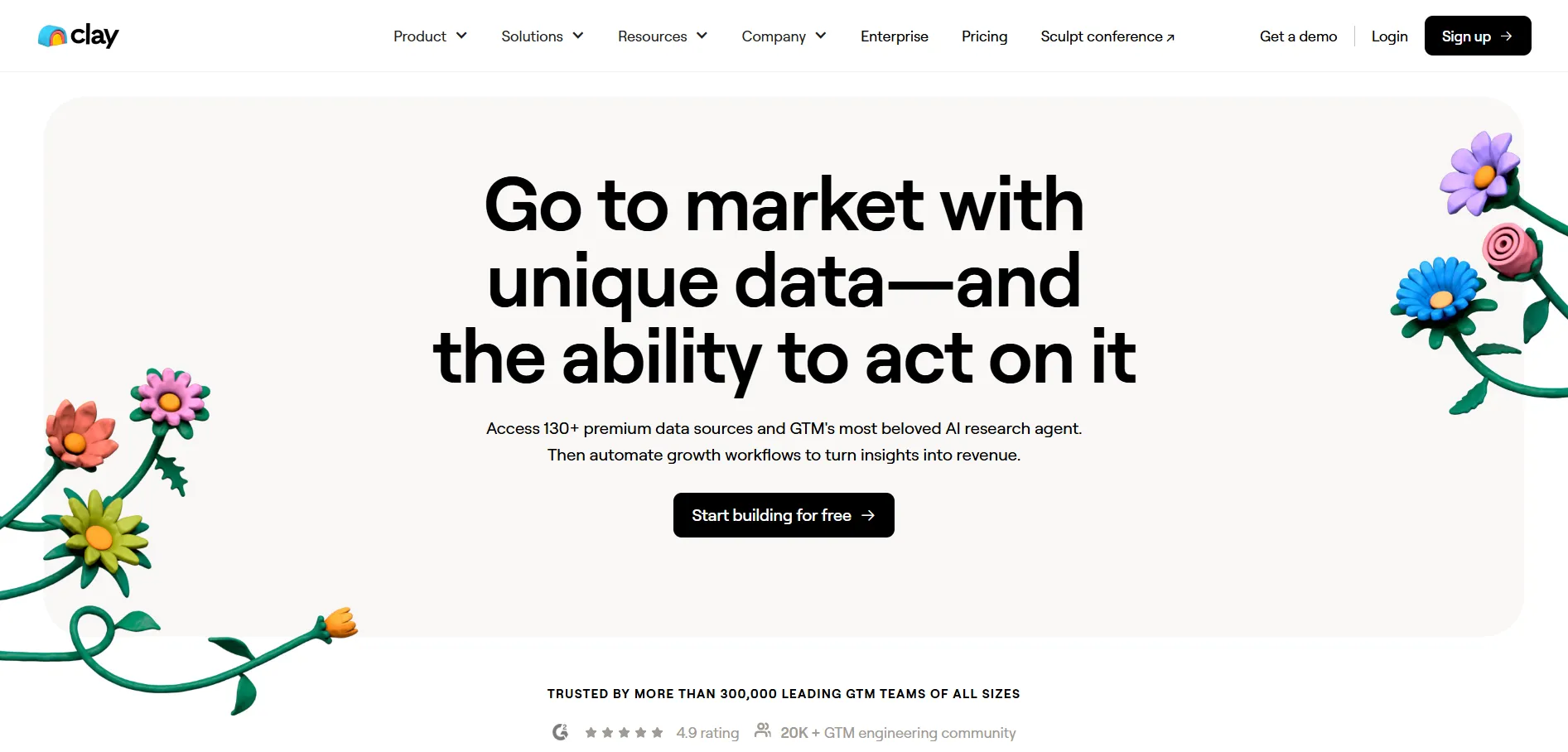
Clay is the orchestration and enrichment layer that makes the entire stack coherent. It pulls signals from multiple upstream sources LinkedIn job data, Crunchbase funding alerts, Bombora intent feeds, Apollo contact data enriches each triggered account with relevant context, scores the account based on signal combination, and routes it to the appropriate sequence in Smartlead or HeyReach. Without Clay, the other four tools produce data in separate silos. Clay is what transforms individual signal streams into a unified, actionable pipeline.
Bombora
Bombora provides the intent intelligence layer tracking B2B content consumption patterns across a network of more than 5,000 publishers to identify accounts that are researching topics relevant to your product category, per Bombora Intent Data Report, 2024. The key differentiation from first-party intent (your own website traffic) is that Bombora captures research activity happening before prospects ever visit your site. This is precisely the dark-funnel research window that represents the majority of the B2B buying journey, and it is the window where your competitors are not yet aware the account is in-market.

6sense
6sense provides predictive buying stage intelligence at the account level, using AI to classify each account into Awareness, Consideration, or Purchase stage based on aggregated behavioural signals. The practical value for lead scoring is not just detecting that an account is showing intent it is knowing where in the buying journey they are. An account at Awareness stage needs educational content; an account at Purchase stage needs a demo request and a direct connection to an AE. 6sense’s buying stage model is what prevents your team from treating all intent signals as equivalent and wasting high-urgency outreach sequences on early-stage researchers.

RB2B
RB2B solves a specific and persistent problem: your website receives hundreds of visits per week from high-intent prospects who never convert, never fill in a form, and never identify themselves. Most companies see this anonymous traffic disappear without acting on it the average B2B website identifies fewer than 5% of its visitors without a dedicated identification layer, per 6sense Revenue AI Benchmark Report, 2024. RB2B turns anonymous website visitors into identified prospect records at the person level not just the company delivering the visitor’s name, LinkedIn profile, and contact information in real time. This transforms your website from a passive demand generation channel into an active signal source, surfacing prospects who are already researching you specifically.

Apollo
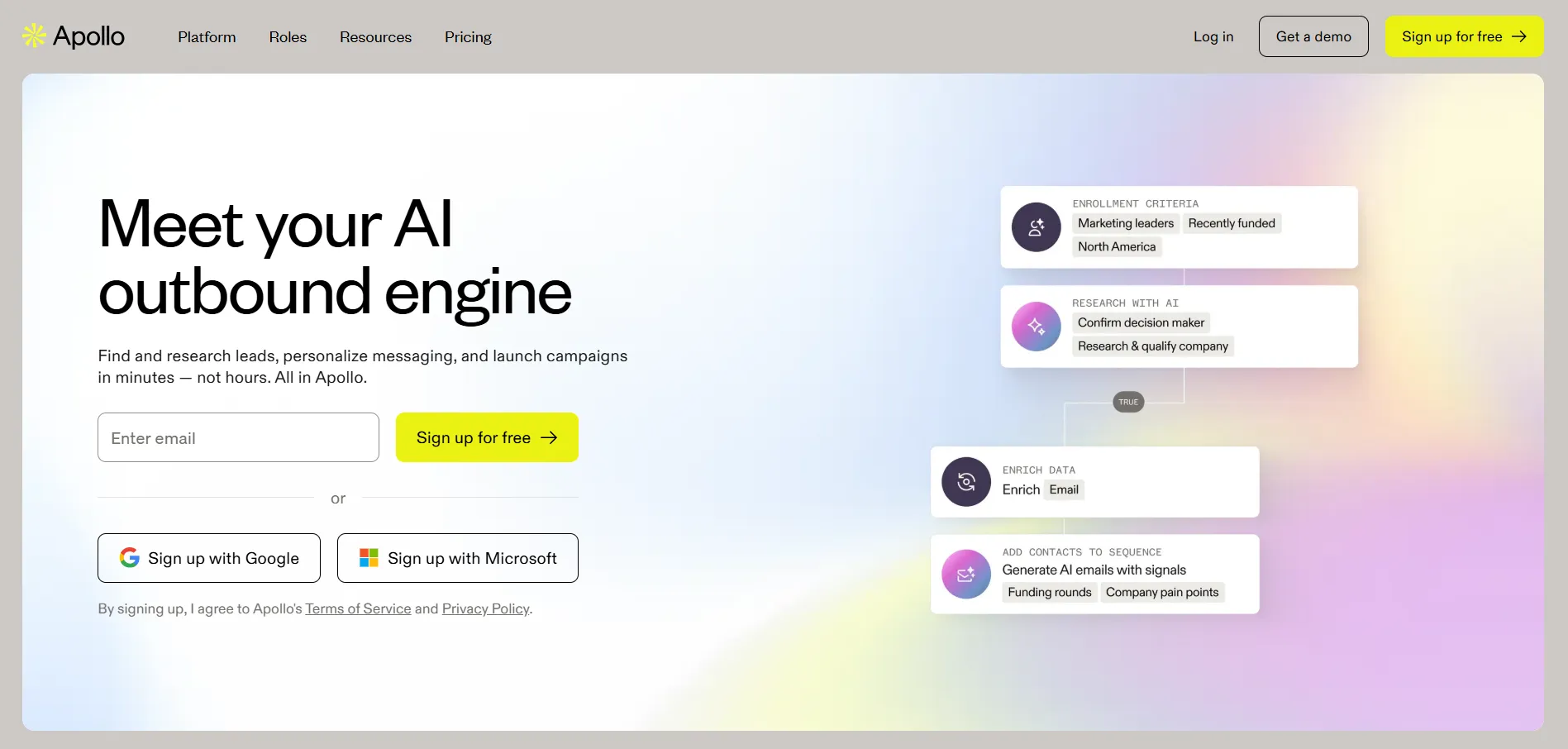
Apollo functions as the contact data coverage and enrichment layer across the stack. When a hiring signal fires for a new VP of Sales at a target account, you need a verified direct email and phone number for that executive within hours, not days. Apollo’s database covers over 275 million contacts with direct dial and verified email, and its real-time enrichment integrates with Clay to fill contact data gaps at the moment a signal is triggered. Apollo also provides hiring signal detection independently its job postings database and LinkedIn integrations allow Clay to pull open role data directly without additional LinkedIn scraping infrastructure.
Signal Stacking: How Combining Signals Multiplies Accuracy
Signal stacking is the practice of requiring two or more concurrent buying signals before routing an account into active outreach and it is the single highest-leverage improvement most B2B outbound teams can make to their lead scoring model. The Contextual Outreach Playbook covers the tactical execution of stacked-signal outreach in detail. This section explains the statistical and practical logic behind why stacking works so reliably.
The reply rate progression from signal stacking follows a consistent pattern across Clay-powered and signal-qualified outbound campaigns. Outreach to static ICP lists with no signal qualification produces reply rates of 1–5% this is the baseline for most cold outbound programmes, per Salesforce State of Sales, 2024. Single-signal targeting (for example, reaching out to all accounts showing purchase-stage intent, regardless of other signals) lifts this to 15–25%. Two stacked signals such as purchase-stage intent combined with a new VP hire pushes reply rates to 25–35%. Three concurrent signals routinely produce reply rates of 35–45%. These figures, drawn from Smarte.pro and Clay-powered campaign data, represent a 7–9x improvement over static list outreach at the three-signal threshold.
The statistical reason for this compounding effect is straightforward. Each individual signal has some false positive rate some percentage of accounts showing that signal that are not actually in an active buying motion. When you require two independent signals to both be present simultaneously, the false positive rate for the combination is the product of the individual false positive rates, not their average. Requiring three concurrent signals reduces false positives further still, to a near-negligible level.
The practical reason is equally compelling: each signal adds a distinct dimension of buying readiness confirmation. A hiring signal confirms organisational change and potential tool re-evaluation. An intent signal confirms active research. A funding signal confirms budget and urgency. An account showing all three simultaneously is not just fitting your ICP it is in a confirmed buying motion with budget, a trigger event, and an active research process underway. Outreach to that account is not interruption; it is the right message at the right moment.
📊 Visual: Reply Rate Curve Single Signal vs Stacked Signals
Bar chart showing reply rate progression: Static ICP list (1–5%) → Single signal (15–25%) → Two stacked signals (25–35%) → Three stacked signals (35–45%). Each bar labelled with signal combination examples.
One practical implementation note: signal stacking requires scoring model transparency. Only 22% of outbound reps say they fully understand why an account is in their queue, per LinkedIn B2B Sales Research, 2024. Your SDRs and AEs need to understand why an account is being surfaced, not just that it has crossed a score threshold. Clay’s enrichment rows and HubSpot property fields make this achievable each triggered account should arrive in the rep’s queue with the specific signals that qualified it, stated in plain language: “New VP Sales hired 12 days ago + Bombora purchase-stage intent in Sales Engagement category + Series B announced 45 days ago.” That context shapes the personalisation, the sequence, and the rep’s opening conversation.
Connecting Signals to HubSpot Scoring
The signal detection and scoring logic above needs to connect to your CRM and sequencing infrastructure to be actionable. The integration architecture below uses Clay as the central webhook layer feeding into HubSpot’s custom scoring property, which then triggers automated workflows and sequence enrolments. This is the same architecture described in the AI Opportunity Scoring post for pipeline prioritisation applied here to the top-of-funnel signal layer.
| Trigger | Score Change | Resulting Action |
|---|---|---|
| Clay detects new VP/Director hire at target account | +40 pts to HubSpot “Signal Score” property | HubSpot workflow assigns the account to an AE and enrolls it into the “New Exec Hire” Smartlead sequence. |
| Bombora/6sense triggers Purchase-stage intent flag | +35 pts to HubSpot “Signal Score” property | HubSpot logs the intent event on the company record; if total score ≥45, the account enters the Tier 1 sequence. |
| Crunchbase/Clay detects Series A/B funding announcement | +30 pts to HubSpot “Signal Score” property | HubSpot appends funding context to the contact record and routes the account into the “Post-Funding” sequence. |
| RB2B identifies anonymous visitor from target account | +20 pts to HubSpot “Signal Score” property | HubSpot creates a new contact if none exists and alerts the assigned rep through Slack automation. |
| Signal Score reaches 2-signal stacking threshold (≥2 concurrent signals) | Automatic Tier 1 flag regardless of total score | Immediate enrollment into the highest-priority LinkedIn + email sequence using HeyReach and Smartlead. |
| Signal Score exceeds 60 pts (stacked, high-confidence) | Account escalated to Sales Qualified Lead status | Assigned AE receives direct notification and the account is added to weekly pipeline review with full signal context. |
The implementation requires three HubSpot configurations: a custom “Signal Score” number property on the company record, a custom “Active Signals” text property that Clay writes the specific signal descriptions to, and a set of score-based workflows that trigger sequence enrolments at the thresholds above. The Clay-to-HubSpot connection runs via Clay’s native HubSpot integration, which can update company and contact properties in real time as enrichment rows complete.
A note on score decay in HubSpot: because HubSpot’s native lead scoring does not support time-based score decay natively, the cleanest implementation is to run score management in Clay where decay logic is straightforward to configure and push only the current, decay-adjusted score to HubSpot on a daily sync. This keeps HubSpot as the routing and workflow layer without requiring complex workarounds for score ageing.
For teams using Smartlead for email sequencing and HeyReach for LinkedIn outreach, both platforms support HubSpot-triggered enrolments meaning the entire detection-to-sequence pipeline can run without manual SDR intervention for initial routing. The SDR’s role shifts from list-building and manual outreach to personalisation review and response handling on signal-qualified accounts. This is the operating model change that drives the meeting volume improvements in the DevCommX benchmark data below.
For deeper context on building the ICP layer that this signal scoring sits on top of, see the AI-Powered ICP Scoring post signal-based scoring without a calibrated ICP model will surface accounts in the right moment but the wrong fit category.
The signal stack described in this post is the detection layer of DevCommX’s managed outbound programme. Clients running signal-qualified targeting hiring signals, intent data, and funding events routed through Clay produced an average of 24.7 qualified meetings per month, at a cost per meeting 67% below the manual SDR benchmark, and an average 42x ROI on programme spend. Signal quality is the single biggest lever on meeting volume the same messaging to a signal-qualified list outperforms a static ICP list by 3–5× in reply rate. Programme access starts at $2,500/month.
Results reflect the full managed programme. Individual outcomes vary by ICP, ACV, and market segment.
Book a strategy call → to see how DevCommX’s signal monitoring layer identifies your highest-intent accounts and routes them into personalised sequences automatically.
Frequently Asked Questions
What are real-time sales signals in B2B?
Real-time sales signals are observable events indicating that a company is currently in an active buying motion. They include hiring events (new executive appointments, open role surges), funding announcements, third-party content consumption spikes in a product category, technographic changes (new tool installs or competitor removals), and anonymous website visits from target accounts. Unlike static demographic attributes, real-time signals capture timing the moment when a company has both a reason to buy and the conditions to act. Tools like Clay, Bombora, 6sense, RB2B, and Apollo detect and surface these signals as they occur, enabling outreach at the highest-probability moment in the buying journey.
How is signal-based lead scoring different from traditional lead scoring?
Traditional lead scoring assigns points to static firmographic attributes (company size, industry, job title) and first-party behavioural events (email opens, page visits, form fills) yet average B2B cold email response rates sit below 8%, per HubSpot State of Sales, 2024. Both categories measure fit and past engagement, but neither reliably indicates whether a company is in an active buying motion right now. Signal-based lead scoring replaces or supplements these inputs with real-time event data events that fire when a company is showing active evidence of a buying problem. The fundamental difference is that traditional scoring optimises for profile match, while signal-based scoring optimises for timing. An account that matches your ICP perfectly but shows no buying signals is less valuable than a slightly smaller account that just hired a new VP, raised a round, and is actively researching your category. Signal-based scoring surfaces the second account; traditional scoring often misses it.
Which buying signals have the highest predictive value?
Champion job changes where a contact who used your product at a previous company moves to a new organisation carry the highest predictive value, with Champify’s research showing a 37% win rate improvement when outreach follows a champion move. New VP or Director hires in the function your product serves rank second, as UserGems’ data shows new executives initiate technology evaluations three to five times more often in their first year. Purchase-stage intent signals from 6sense and Bombora are the third highest-value category, with 6sense reporting 29× higher opportunity creation rates for Purchase-stage versus Awareness-stage accounts. Funding signals and technographic changes follow, each providing independent confirmation of an active evaluation or expanded budget window.
What tools do B2B teams use for real-time signal monitoring?
The five-tool stack most commonly used by high-performing outbound teams is: Clay (signal aggregation, enrichment, and routing), Bombora (third-party intent data across 5,000+ publishers), 6sense (predictive buying stage classification), RB2B (anonymous website visitor identification at the person level), and Apollo (contact data enrichment and hiring signal detection). These tools address different parts of the signal detection problem and are designed to be used in combination rather than as standalone solutions. G2’s sales intelligence category covers additional tools in the broader signal monitoring space for teams evaluating alternatives and G2’s own buyer intent data shows that 67% of B2B buyers research products on review sites before engaging vendors, per G2 Buyer Behavior Report, 2024.
What is signal stacking and why does it improve reply rates?
Signal stacking is the practice of requiring two or more concurrent buying signals before routing an account into active outreach. It improves reply rates for two reasons. Statistically, requiring multiple independent signals to fire simultaneously reduces the false positive rate multiplicatively if each individual signal has a 30% false positive rate (fires on accounts not in a buying motion), requiring two concurrent signals reduces the false positive rate to approximately 9%, and three signals to approximately 2.7%. Practically, each concurrent signal adds a distinct dimension of buying readiness confirmation timing (hiring), budget (funding), and research activity (intent) can each be independently verified. The result is that stacked-signal outreach produces reply rates of 25–35% for two signals and 35–45% for three, compared to 1–5% for static list outreach. See the Contextual Outreach Playbook for the full stacking data and tactical sequence structures.
How do I connect real-time signals to my HubSpot lead scoring?
The recommended integration architecture uses Clay as the central processing layer. Clay detects signals from Bombora, 6sense, Crunchbase, LinkedIn, and RB2B, calculates the composite signal score with decay applied, and pushes the updated score to a custom “Signal Score” number property on the HubSpot company record via Clay’s native HubSpot integration. A second custom property “Active Signals” receives a plain-language description of the specific signals that qualified the account. HubSpot workflows then monitor the Signal Score property and trigger sequence enrolments in Smartlead or HeyReach when score thresholds are crossed. The full trigger-to-action flow is detailed in the HubSpot integration table in this post. Because HubSpot’s native scoring does not support time-based decay, score management should run in Clay with a daily sync to HubSpot to keep the scoring current.
References
https://business.linkedin.com/sell
https://blog.hubspot.com/sales/hubspot-sales-strategy-report?hubs_content=blog.hubspot.com
https://6sense.com/science-of-b2b/buyer-experience-report-2025/
https://www.forrester.com/research/buyer-insights/
https://www.forrester.com/report/2024-b2b-marketing-budget-benchmarks-overview/RES181610

Planning your next GTM move? Get a quick audit of your sales, outbound, and RevOps systems.
More Blogs















.webp)

















Book Your Free GTM Audit
Replace manual prospecting with intelligent automation.
Let your sales team focus on closing.